
From Ancient Rituals to Canada's Highest Bungee: The History of Bungee Jumping
Today, bungee jumping is one of the world's most recognizable adventure sports. Every year, millions of people step off bridges, cranes, towers, and cliffs in search of the ultimate adrenaline rush. But the story of bungee jumping began long before commercial adventure tourism—it started centuries ago with an ancient tradition in the South Pacific.
The Origins of Bungee Jumping
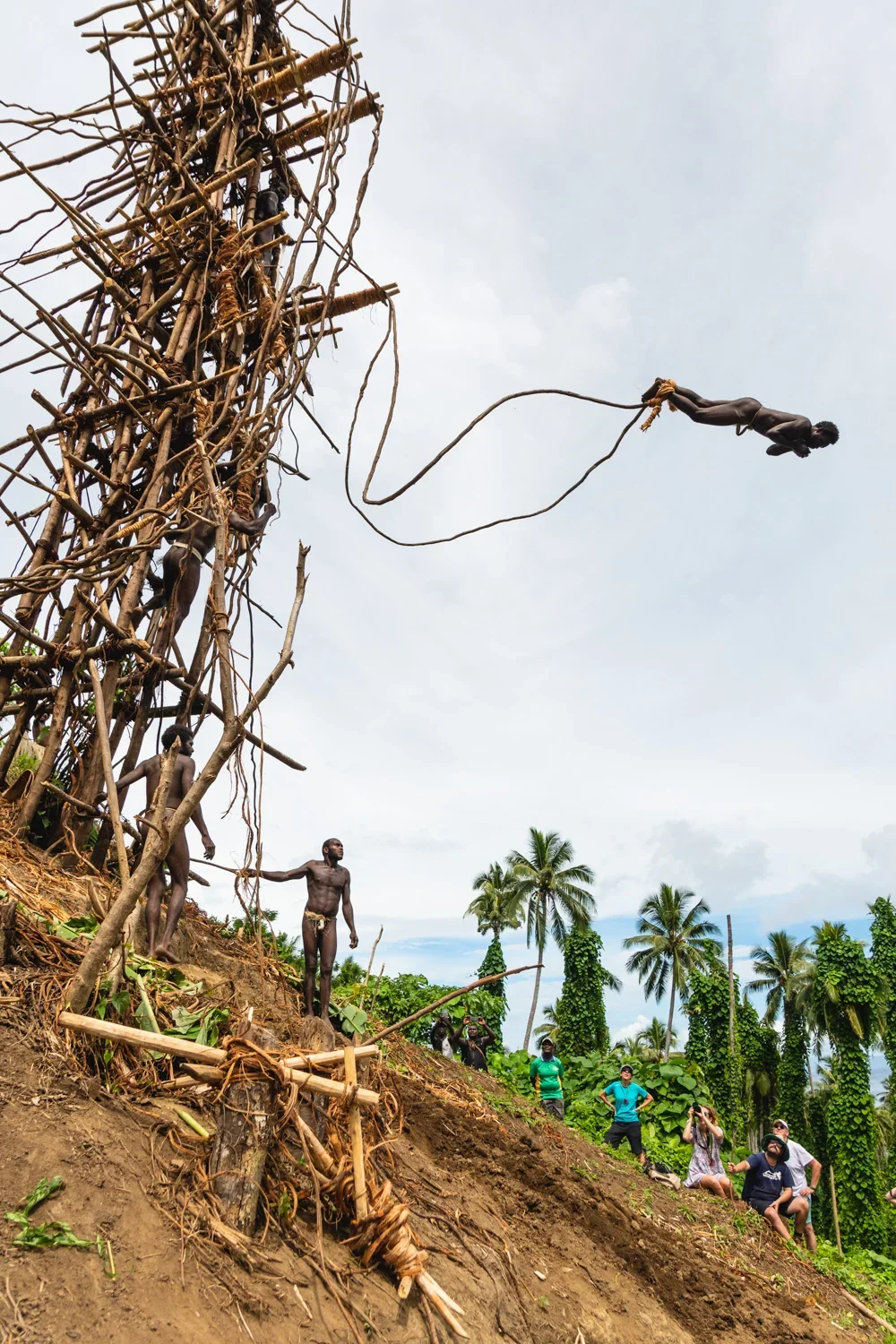
The roots of modern bungee jumping can be traced to Pentecost Island in Vanuatu, where villagers have practiced a ritual known as land diving for hundreds of years.
During this ceremony, men climb wooden towers over 20 metres high with vines tied around their ankles before leaping toward the ground. The tradition is deeply rooted in local culture and symbolizes courage, manhood, and a successful harvest season. Unlike modern bungee jumping, the goal is to come as close to the ground as possible, with the vines carefully selected to stop the fall at just the right moment.
Although modern bungee equipment looks very different, the concept of willingly taking a leap into the unknown began here.
The Birth of Modern Bungee Jumping
Fast forward to April 1, 1979.
A group of adventurous students from the Oxford University Dangerous Sports Club made history by performing what is widely recognized as the first modern bungee jump. Using elastic cords instead of vines, they leapt from the Clifton Suspension Bridge in Bristol, England.
While the jump resulted in a brief encounter with local police, it also sparked worldwide curiosity. The idea of recreational bungee jumping had officially arrived.
Over the next few years, members of the club continued experimenting with jumps from bridges and other structures, inspiring adventure enthusiasts around the globe.
AJ Hackett Changes Everything
Although the Oxford students introduced the concept, it was A.J. Hackett, a New Zealander, who transformed bungee jumping into a commercial adventure sport.
Throughout the 1980s, Hackett refined equipment, safety systems, and jumping techniques. His most famous stunt came in 1987, when he illegally jumped from the Eiffel Tower in Paris. The dramatic event captured international media attention and introduced millions of people to the sport.
Soon afterward, Hackett opened the world's first permanent commercial bungee operation at the Kawarau Bridge in Queenstown, New Zealand.
That bridge remains one of the world's most iconic bungee destinations today.
BUNGEE JUMPING IS BROUGHT TO THE MASSES
The history of commercial bungee jumping in North America is closely connected to two California brothers, John and Peter Kockelman. In the late 1980s, they helped transform an unusual daredevil activity into an experience available to paying customers. Their story brings together adventure, engineering and entrepreneurship—and extends beyond the United States into the development of Canadian bungee jumping.
The Kockelmans entered the story in 1987. According to a contemporary profile, John proposed that he and Peter try jumping from a bridge near Don Pedro Reservoir in California. Peter, an engineer then working on guidance and control systems, brought technical knowledge to the undertaking. Their partnership combined John’s appetite for ambitious stunts with Peter’s attention to whether those ideas could be carried out safely.
What began as a personal adventure soon became a business. Although some retrospective accounts date their commercial beginnings to 1987, a June 1990 United Press International report makes a useful distinction: the brothers began jumping in October 1987 and went commercial in May 1988. Their company, Bungee Adventures, is widely credited as the first commercial bungee-jumping business in the United States.
The important change was access. Participants could now join an organized excursion and jump under the brothers’ supervision. By June 1990, UPI reported that the Kockelmans had supervised more than 9,000 bridge jumps. They were also experimenting with alternative platforms. Peter obtained a pilot’s licence, and the brothers purchased and specially reinforced a hot-air balloon for commercial jumping. These ventures expanded the possibilities for where—and how—the public could experience bungee jumping.
Their influence also travelled through training other operators. The first trainee was Matthew Lawrence, who initially encountered bungee jumping in New Zealand in 1988, and soon after received formal training from John and Peter in California. Lawrence founded the Great Canadian Bungee Corporation in 1990, and its permanent site at Morrison’s Quarry in Chelsea, Quebec, celebrated its grand opening in 1992. This provides a direct link between the Kockelmans’ pioneering California operation and the development of a major Canadian jumping destination.
The Canadian story also illustrates the growing emphasis on organized operating practices. According to its published history, Great Canadian Bungee helped establish the Canadian Bungee Association in 1992 and authored safety guidelines for the organization. Training, equipment development and formal guidelines became part of building an enduring industry around the original thrill of the jump.